What Are Those Metal Fins Inside Your Ductwork? (And Why Your Upstairs Bedroom Is Still an Oven)
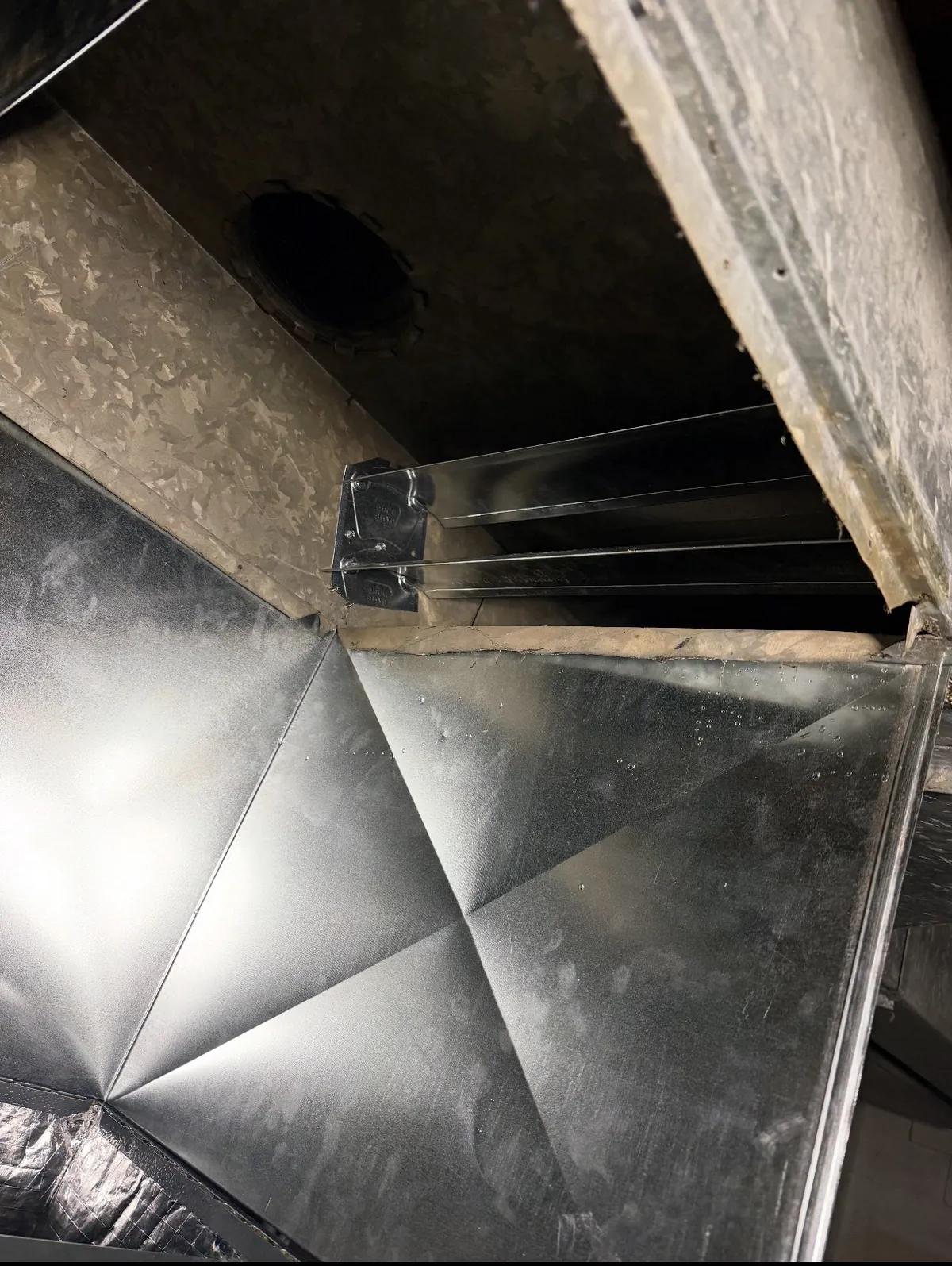
If you have ever popped a vent cover off or peeked inside a duct chase and seen a set of metal fins that look like window blinds or an airplane wing crammed into a sheet metal elbow, you are looking at turning vanes. And if your house does not have them, there is a good chance your upstairs bedroom is an oven in July and a walk-in freezer in January.
That photo above is real Triple Check ductwork, not a stock render. Those vanes are doing more work than most homeowners ever realize.
What Turning Vanes Actually Do
Air does not like corners. When your blower pushes air down a trunk line and that air hits a 90-degree elbow, it wants to keep going straight, slam into the outside wall of the elbow, tumble, and choke. Turning vanes split that airstream into smaller lanes and guide it around the corner smoothly, the same way a NASCAR driver uses the banking in a turn instead of slamming the wall and hoping for the best.
Without vanes, an elbow acts like a kinked garden hose. The air tumbles, pressure builds up on the supply side, and the rooms at the far end of the run get whatever is left over. Which is usually not much.
The Ferrari on a Capri Sun Straw
Here is the part most homeowners never hear: your furnace or air handler is sized to move a certain amount of air against a certain amount of resistance. That resistance is called static pressure, and every elbow, transition, flex duct sag and crushed vane adds to it.
High static pressure is like asking a Ferrari to breathe through a Capri Sun straw. The engine is fine. The airflow path is the problem. We see it constantly in Northeast Kansas homes:
- ECM blower motors burning out early because they ramp up harder and harder trying to overcome the resistance, until the module gives up. That is a four-figure repair caused by fifty cents of sheet metal.
- Hot and cold rooms at the end of long runs, especially upstairs bedrooms over garages.
- Whistling vents and noisy ducts from air being forced through restrictions.
- Higher utility bills because the system runs longer to do the same job.
Why the Upstairs Bedroom Is Always the Victim
Heat rises, so in winter the upstairs should be the easy win. But the upstairs runs are usually the longest, with the most elbows, fed off the end of the trunk. If the elbows near the air handler are eating airflow with turbulence, the last register on the line gets starved first. In summer, that same starved run is trying to push cold air uphill into the hottest room in the house.
This is why we fabricate transitions and elbows with proper turning vanes instead of just folding a piece of metal into a corner and calling it good. SMACNA sheet metal standards exist for a reason, and "we have always done it this way" is not an airflow strategy.
Where Airflow Meets Plumbing: The Overlooked Condensate Trap
High static pressure does not just choke your blower motor. In the summer, that same choked airflow across your evaporator coil can cause water to pull off the coil and pool where it should not, overwhelming the condensate drain. Next thing you know, you have water staining the ceiling below the air handler or a puddle in the mechanical room, and everybody assumes it is a plumbing leak.
Because Triple Check handles both HVAC and plumbing services in Atchison, KS (and we are a licensed electrical contractor when equipment hookups require it), we check the whole picture: from your sheet metal airflow down to your condensate drains, water lines and utility room plumbing. If your mechanical room has water where it should not, we find the real cause and fix the ductwork and the plumbing in one visit. Check out our plumbing services in Atchison if that puddle turns out to be pipes after all.
What a Real Airflow Diagnosis Looks Like
Guessing is free and usually wrong. When we get called out for uneven temperatures, we actually measure:
- Total external static pressure across the system, compared to what the blower is rated for
- Temperature split across the coil or heat exchanger
- Airflow at the problem registers, not just at the equipment
- The ductwork itself, including elbows, transitions, sagging flex duct and crushed or missing turning vanes
Our diagnostic visit starts at $120. You get real numbers, a plain-English explanation of what is choking your system, and an upfront quote for the fix before any work starts.
The Triple Check Standard
Every system we install or repair gets the same four-point check:
- Manual J load calculations so the equipment is actually sized for your house
- Static pressure testing before and after the work
- Fabricated transitions and elbows with turning vanes, not folded sheet metal and hope
- Airflow balancing so the last register on the run gets its fair share
We do not just swap boxes and hope for the best.
Is Your Ductwork the Problem?
If you have a room that never matches the thermostat, a blower motor that has already been replaced once, or ducts that sound like a wind tunnel every time the system kicks on, the ductwork is the first place to look. Call (913) 426-2588, request a diagnostic visit, or see our HVAC services for Atchison and Northeast Kansas.
Need Professional Help?
Our experienced team is ready to assist with your construction project. Contact us today for a free consultation.
Get a Free QuoteRelated Articles
What Northeast Kansas Homeowners Need to Know About the New Refrigerant Rules — and How to Stay Cool This Summer
R-410A is being phased out in favor of new A2L refrigerants like R-454B and R-32. Here's what that means for your AC, your wallet, and staying cool through a Kansas summer.
The Best HVAC Systems of 2026: A Contractor's Honest Ranking
After decades in construction and thousands of HVAC units installed — including running the HVAC division for Tasman on U.S. military bases — Triple Check ranks the top 5 residential HVAC brands for 2026.